

Generator Interlock Kits vs. Transfer Switches: What Metro Detroit Homeowners Should Know Before the Power Goes Out
When the power goes out in Macomb or Oakland County — a downed line after a summer storm, an ice storm that keeps DTE crews working for days — most of the homeowners we talk to already own the fix: a portable generator sitting in the garage. The real question isn't whether to buy one. It's how to connect it to the house safely, and that decision usually comes down to two options: a generator interlock kit or a transfer switch.
Here's how the two actually compare, why we steer most Metro Detroit homeowners toward one of them, and what to avoid if you're running a portable generator during an outage right now.
Why You Can't Just Plug a Generator Into an Outlet
Before comparing interlocks and transfer switches, it's worth being direct about the shortcuts that put people at real risk. We still run into all three of these after nearly every major storm:
- Backfeeding through a dryer or range outlet — running a cord from the generator into a 240V dryer or range outlet to "push" power back into the house. It can work for a few minutes, but it also energizes the utility lines outside your home, which can seriously injure or kill a DTE lineman working on what they believe is a dead line.
- Running extension cords into the house — through a cracked window or door to power a few lamps and the fridge. Household extension cords aren't rated for the load a furnace, sump pump, or well pump actually draws, and they turn every doorway into a trip hazard for the length of the outage.
- Running the generator too close to the house — near a window, door, or garage opening. Portable generators produce carbon monoxide, and it collects fast in an enclosed or partially enclosed space. It needs to run well away from the house with the exhaust pointed away from windows and doors.
An interlock kit or transfer switch solves all three problems at once: the generator connects through a dedicated, weatherproof inlet on the outside of the house, and the house's wiring is physically prevented from being connected to both the utility and the generator at the same time.
Interlock Kit or Transfer Switch: What's Actually Different
Quick scope note: this comparison is about portable generators — the kind you store in a garage or shed and roll out during an outage. A permanently installed whole-home standby generator (the kind that starts itself and switches over automatically) uses an automatic transfer switch by design, which is a different setup than what's covered here.
What a Mechanical Interlock Kit Does
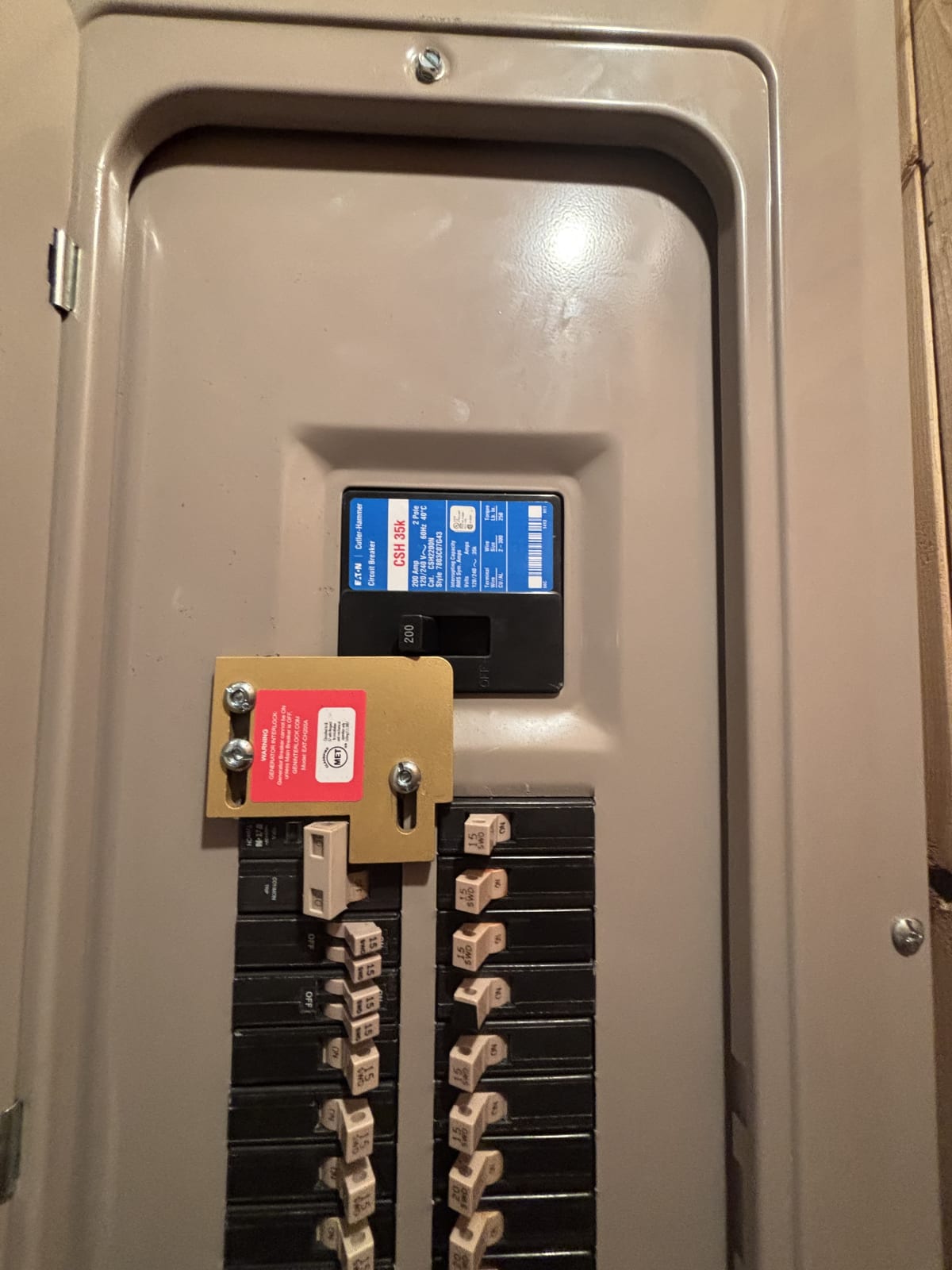
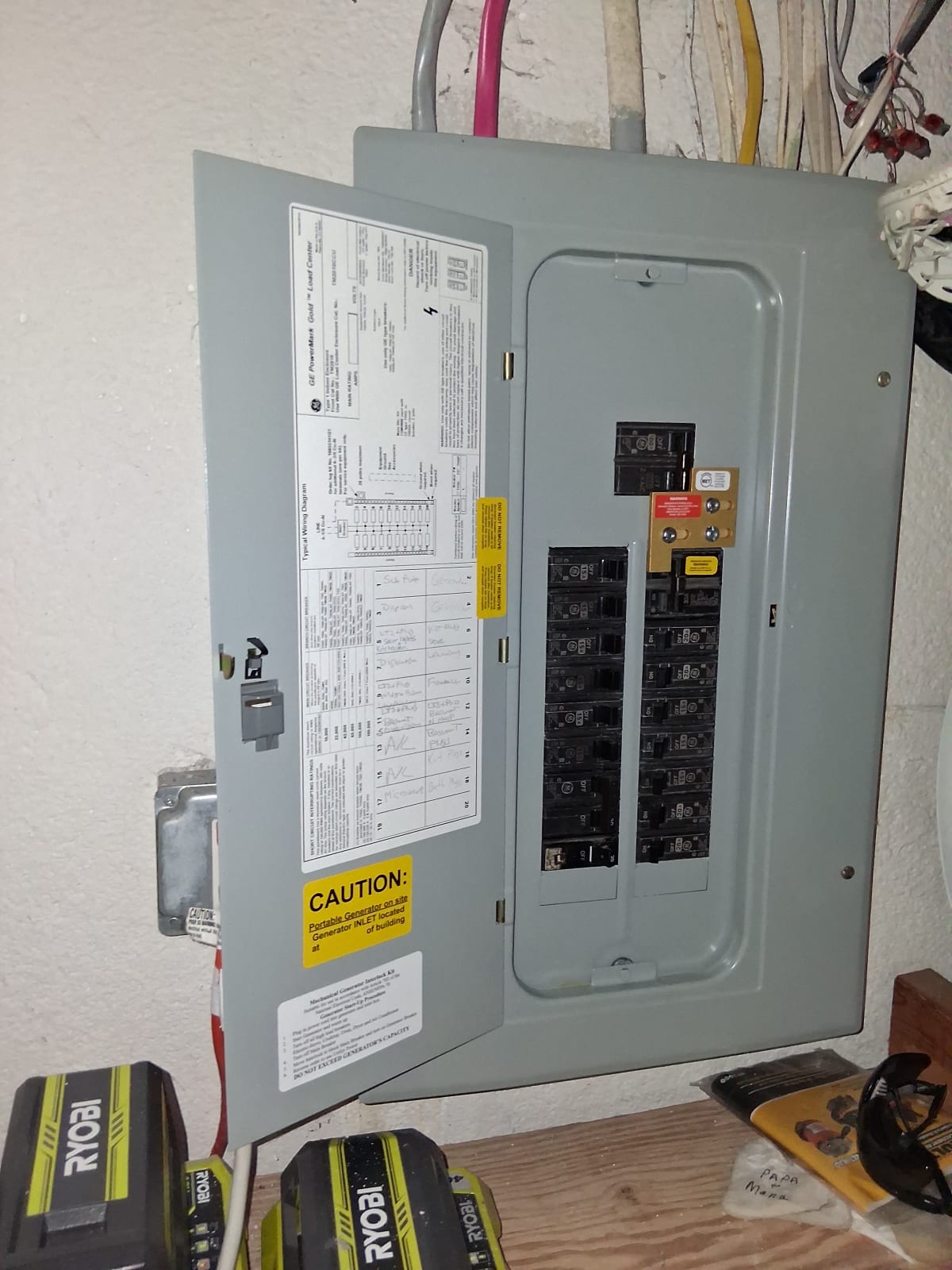
An interlock kit is a small mechanical piece — usually a sliding metal plate — installed on the panel cover itself. It physically prevents your main breaker and a dedicated generator breaker from both being switched on at the same time. Flip the main off, and the interlock lets you flip the generator breaker on; there's no way to have both live at once. From there, you manually turn on whichever individual circuit breakers you want the generator to power.
What a Transfer Switch Does
A transfer switch is a separate small sub-panel installed next to your main panel, pre-wired to a fixed set of circuits — typically 6 to 10. When the power goes out, you switch that sub-panel over to generator power, and only those pre-selected circuits get it. Everything else in the house stays off no matter how much spare capacity the generator has.
| Interlock Kit | Transfer Switch | |
|---|---|---|
| Circuits powered | Any breaker in the panel, your choice each time | Fixed set, usually 6–10 circuits |
| Flexibility | High — swap priorities outage to outage | Low — locked in at install |
| Typical use case | Portable generator, most single-family homes | Portable generator, smaller fixed critical-load list |
| Panel requirement | Must be listed for your specific panel model | Installed as its own sub-panel |
Why We Steer Most Homeowners Toward an Interlock Kit
We install both, but we recommend an interlock kit to most homeowners, and it comes down to one thing: control. A transfer switch locks you into whichever circuits it was wired to on installation day — usually the furnace, the fridge, and a handful of outlets. An interlock kit gives you the whole panel. If it's summer and the air conditioner matters more than the sump pump, you choose that. If a storm hits in January and the furnace and well pump are the priority, you choose that instead. You're not limited to 6 or 10 circuits picked once and left alone — the only real limit is what your generator can put out.
What's Actually Involved in a Generator Interlock Installation
- Load calculation — matching your generator's output (or the one you're planning to buy) to the circuits you actually want to run, so the panel isn't asked to do more than the generator can supply.
- Confirming the interlock is listed for your exact panel — an interlock kit isn't a universal accessory. It has to be factory-listed for your specific panel make and model, not just physically able to fit. This is one of the most common corners cut by unlicensed installs.
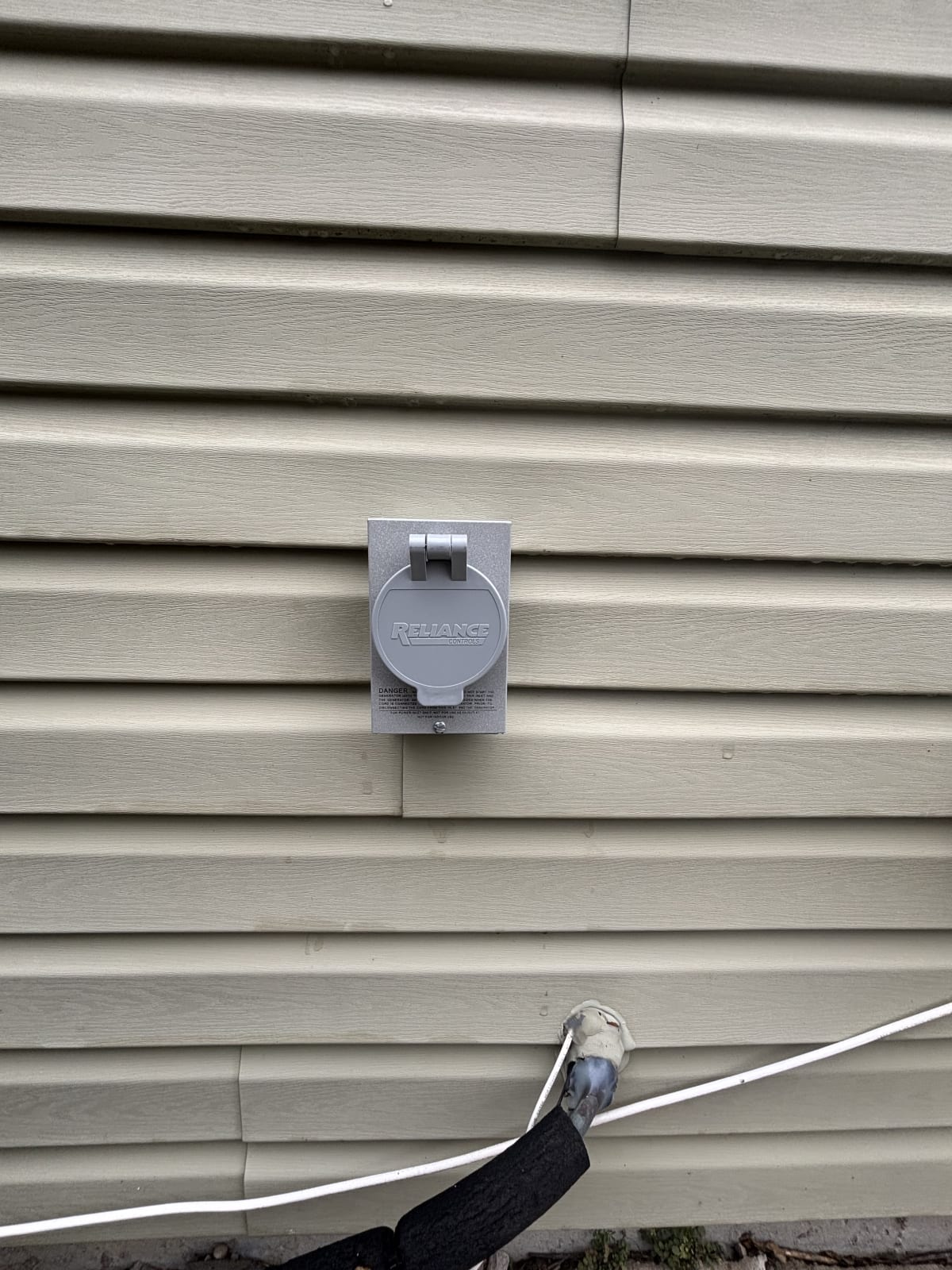
- Installing an outdoor power inlet box — a weatherproof connection point on the outside of the home where the generator's cord plugs in, sized as a 30-amp or 50-amp inlet depending on the generator and the circuits it needs to carry.
- Permit and inspection — required under the Michigan Electrical Code for any generator interlock or transfer switch installation.
- Labeling — clear instructions posted at the panel showing the correct startup and shutdown sequence, so anyone in the house can operate it safely, not just the person who was there for the install.
What It Costs in Metro Detroit
Most interlock kit installations we do run $800 to $1,500, depending on three things: how difficult the panel access is, how far the panel is from where the outdoor inlet needs to go, and whether a 30-amp or 50-amp inlet fits the generator. A straightforward job on an easily accessible panel lands toward the lower end; longer cable runs, tighter panel locations, or a 50-amp setup push it higher. A real number for your home takes a quick look at the panel and a conversation about your generator — that's what the free quote is for.
Ready to stop wondering what happens the next time the power goes out? Call 586-489-1504 or see how our generator hookup service works to get a real number for your home.
Mistakes We See Homeowners Make With Portable Generators
- Running the generator too close to the house — right outside a window or in an attached garage with the door cracked. Carbon monoxide from a portable generator can build up to dangerous levels in minutes in that kind of setup.
- Backfeeding through a dryer or range plug — the most dangerous shortcut on this list, and the reason interlock kits and transfer switches exist in the first place.
- Running extension cords instead of using a proper inlet — undersized for the load, and a tripping hazard strung through a door or window for the length of the outage.
Master Electrician Safety Note
Backfeeding a house through a dryer or range outlet doesn't just risk the people inside — it can put voltage back onto lines that utility crews are actively working on, believing them to be dead. If you're using a portable generator without an interlock or transfer switch installed, don't connect it to the house wiring at all — run individual appliances directly off the generator with its own cords instead.
What Homeowners Can Safely Check (and What Not to Touch)
Safe to check yourself: where your outdoor generator inlet is located, what amperage it's rated for (it's usually printed on the inlet cover), and whether the startup/shutdown instructions are still legible at the panel. It's also worth knowing your generator's running wattage and roughly comparing it to what you'd want to run at once — furnace, fridge, sump pump, a handful of lights — before an outage happens, not during one.
Not something to take on yourself: opening the panel to install the interlock hardware or a generator breaker, wiring the outdoor inlet back to the panel, or deciding which interlock kit is actually listed for your panel model. That last part matters more than it sounds — the wrong interlock can look like it fits and still not be a code-compliant, safe pairing.
When to Call a Licensed Electrician
Call before you buy the generator, not after, if you can — sizing the generator to your actual priority circuits is easier to plan up front than to work backward from a unit you already own. Beyond that, call if your current panel is already full or outdated — a lot of the 100A panels we replace in Sterling Heights and Warren simply don't have room for a generator breaker without other changes first, which is usually the same conversation as a 100A to 200A panel upgrade — or if you're not sure whether your panel has a factory-listed interlock option at all.
How TNE Handles a Generator Interlock Installation
We start with a load calculation based on your actual generator (or help you size one if you haven't bought it yet), confirm the interlock kit that's listed for your specific panel, and walk the property with you to pick an inlet location that keeps the cord run short and out of the way. From there it's a permitted install with an inspection, and before we leave, we walk through the startup and shutdown sequence with you in person — not just a sticker on the panel — so the first time you use it isn't during a storm at 11 p.m.
Looking at your home's power reliability more broadly? Our guide on preparing your home's power before Michigan winter storms hit covers whole-home surge protection and other steps worth pairing with a generator setup.
FAQ
Can I just plug my portable generator into an outlet in my house?
No. Plugging a generator into a wall outlet or a dryer/range outlet to backfeed the house is dangerous — it can send power out onto utility lines that crews believe are dead, and it bypasses the circuit protection built into your panel. An interlock kit or transfer switch is the safe way to connect a generator to your home's wiring.
What's the real difference between an interlock kit and a transfer switch?
An interlock kit gives you access to any breaker in your panel, one at a time, so you choose what runs based on that day's priorities. A transfer switch is wired to a fixed set of circuits — usually 6 to 10 — chosen once at install and locked in after that.
Is a transfer switch ever the better choice?
For a portable generator, we recommend an interlock kit in almost every case we see — the flexibility is worth more than the slightly simpler operation of a transfer switch. Transfer switches make more sense as part of a permanently installed, automatic whole-home standby generator system, which is a different kind of setup entirely.
What size generator do I need?
It depends on which circuits matter most to you during an outage — furnace, sump pump, refrigerator, and a few lights is a common baseline. We run the actual load calculation as part of the interlock installation so the generator and the wiring are sized to match.
Do I need a permit for a generator interlock installation in Michigan?
Yes. It requires a permit and inspection under the Michigan Electrical Code, the same as a panel upgrade or a transfer switch installation. We handle both as part of the job.
How much does a generator interlock kit cost in Metro Detroit?
Most of our installations run $800 to $1,500, depending on panel access, the distance from the panel to the outdoor inlet, and whether a 30-amp or 50-amp inlet fits your generator.
Have a portable generator sitting in the garage waiting for the next outage? Call 586-489-1504 for a real look at your panel and a straight answer on interlock vs. transfer switch for your home.
More electrical advice for homeowners
Explore more homeowner-friendly electrical tips, safety advice, and upgrade ideas from our team.
Electrical Services For Your Home
Use our simple booking tool to schedule electrical service or get a rough estimate for common projects. Choose a time that works for you and we'll take care of the rest.